10 This glossary is to expand my vocabulary and learn to relate to more words on this subject. terms
This glossary is a task, I've been working on it for two days, in this glossary you can find words on the topic of convection
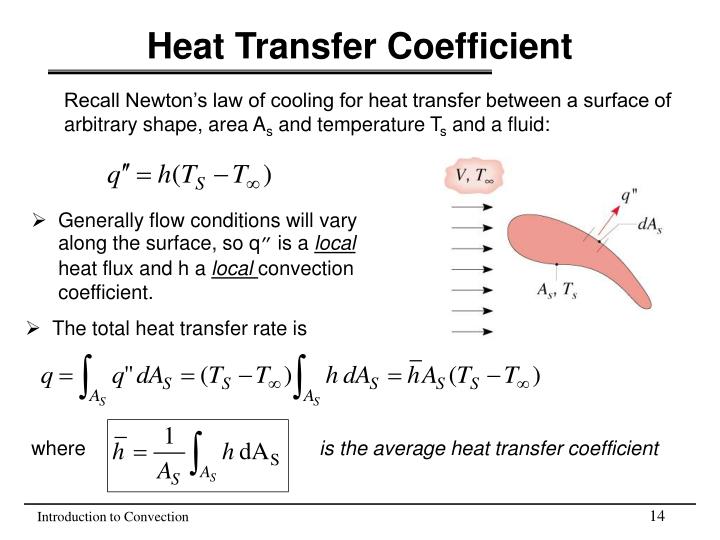
Convection heat transfer coefficient
conjunction
The rate of heat transfer between a solid surface and a fluid per unit surface area per unit temperature difference.
Example: As can be seen, the constant of proportionality will be crucial in calculations and it is known as the convective heat transfer coefficient, h. The convective heat transfer coefficient,
en: Coeficiente de transferencia de calor por convección
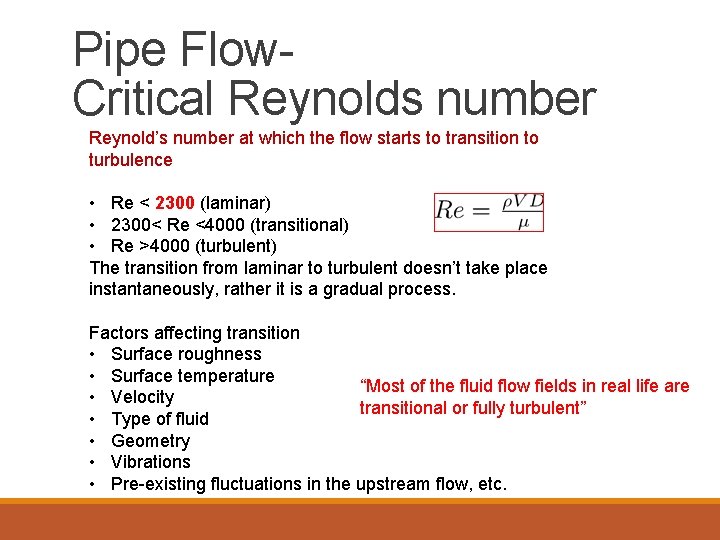
Critical Reynold’s number
phrase
A critical Reynolds number is determined as a limit where the laminar flow changes to turbulent flow. If the calculated NRe is greater than the critical Reynolds number NRec, the flow regime is turbulent; otherwise the flow regime is laminar.
Example: Whilst the critical Reynolds number for turbulent flow in a pipe is 2000, the critical Reynolds number for turbulent flow over a flat plate, when the flow velocity is the free-stream velocity, is in a range from 105 to 106. 4
en: Número crítico de Reynolds
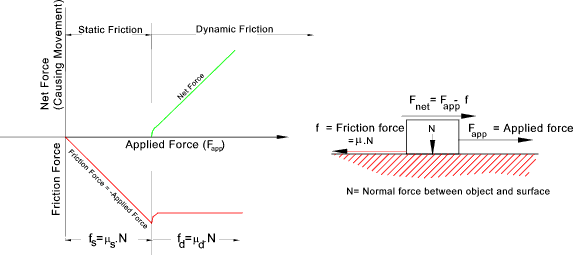
Friction Coefficient
noun
The coefficient of friction (COF) may be adjusted upward or downward by the use of fillers [16]. Addition of low COF fillers such as graphite, hexagonal boron nitride, PTFE, paraffin wax, or molybdenum disulfide will reduce the COF.
Example: The theoretical optimisation of disc brakes is primarily associated with the geometry of the disc and pad assembly, along with the FRICTION COEFFICIENT of the pad material.
en: Coeficiente de fricción
Kinematic viscosity
noun
Kinematic viscosity is a measure of a fluid's internal resistance to flow under gravitational forces.
Example: This is not as intuitive as absolute viscosity as it would appear, take air as an example which under standard conditions has a higher KINEMATIC VISCOSITY than water owing to its lower density.
en: Viscosidad cinemática
Laminar flow
noun
In fluid dynamics, laminar flow is characterized by fluid particles following smooth paths in layers, with each layer moving smoothly past the adjacent layers with little or no mixing.
Example: Large inertial forces seem to tend toward a turbulent flow being present in comparison to a high viscosity which oppositely tends to create a rather more LAMINAR FLOW.
en: Flujo laminar
Nusselt number
phrase
The Nusselt number is a dimensionless number that measures the increase in heat transfer from a surface through which a fluid passes compared to the heat transfer if it occurred only by conduction.
Example: The NUSSELT NUMBER is defined as the ratio of convection heat transfer to fluid conduction heat transfer under the same conditions.
en: Número de Nusselt
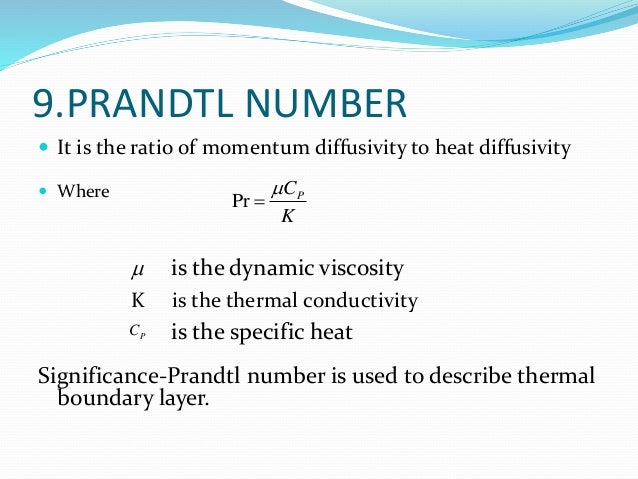
Prandtl number
phrase
The Prandtl number (Pr) or Prandtl group is a dimensionless number, named after the German physicist Ludwig Prandtl, defined as the ratio of momentum diffusivity to thermal diffusivity.
Example: In heat transfer problems, the PRANDTL NUMBER controls the relative thickness of the momentum and thermal boundary layers. When Pr is small, it means that the heat diffuses quickly compared to the velocity (momentum).
en: Número de prandtl
Reynold number
conjunction
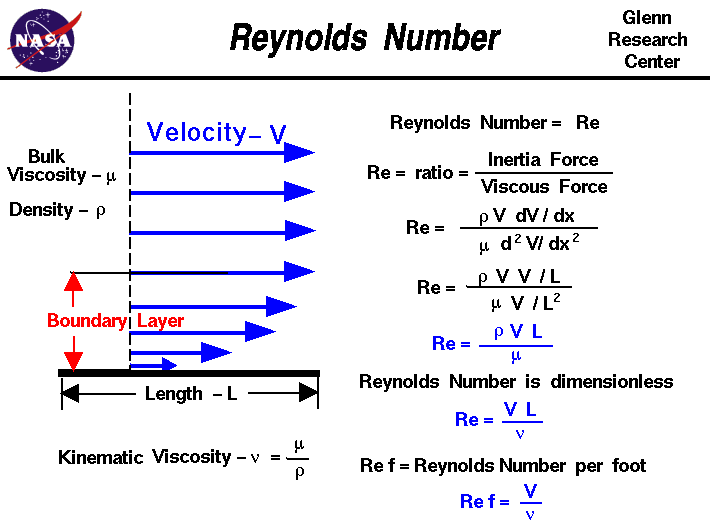
The Reynolds number (Re) helps predict flow patterns in different fluid flow situations. At low Reynolds numbers, flows tend to be dominated by laminar (sheet-like) flow, while at high Reynolds numbers flows tend to be turbulent.
Example: This can occur around cylinders and spheres, for any fluid, cylinder size and fluid speed, provided that it has a REYNOLDS NUMBER between roughly 40 and 1000.
en: Número de Reynold
Shear stress
adjective
Shear stress, force tending to cause deformation of a material by slippage along a plane or planes parallel to the imposed stress.
Example: The SHEAR STRESS and shear rate is calculated, and each of these is related to the torque and angular velocity respectively.
en: Esfuerzo cortante
Turbulent flow
noun
Turbulent flow, type of fluid (gas or liquid) flow in which the fluid undergoes irregular fluctuations, or mixing, in contrast to laminar flow, in which the fluid moves in smooth paths or layers.
Example: Large inertial forces seem to tend toward a TURBULENT FLOW being present in comparison to a high viscosity which oppositely tends to create a rather more laminar flow.